The most expensive customer a negative review costs you is the one you never meet. They look you up, read a complaint, and choose someone else. They don't phone to tell you why, and they never show up in your figures as a lost sale. That's why the cost of negative reviews is so easy to underestimate. You can't count the people who left, but you can count what drives them away, and the research is clear.
Nearly every customer reads reviews before choosing a local business, and most are put off by what they find in the bad ones.
Almost Every Customer Checks You First
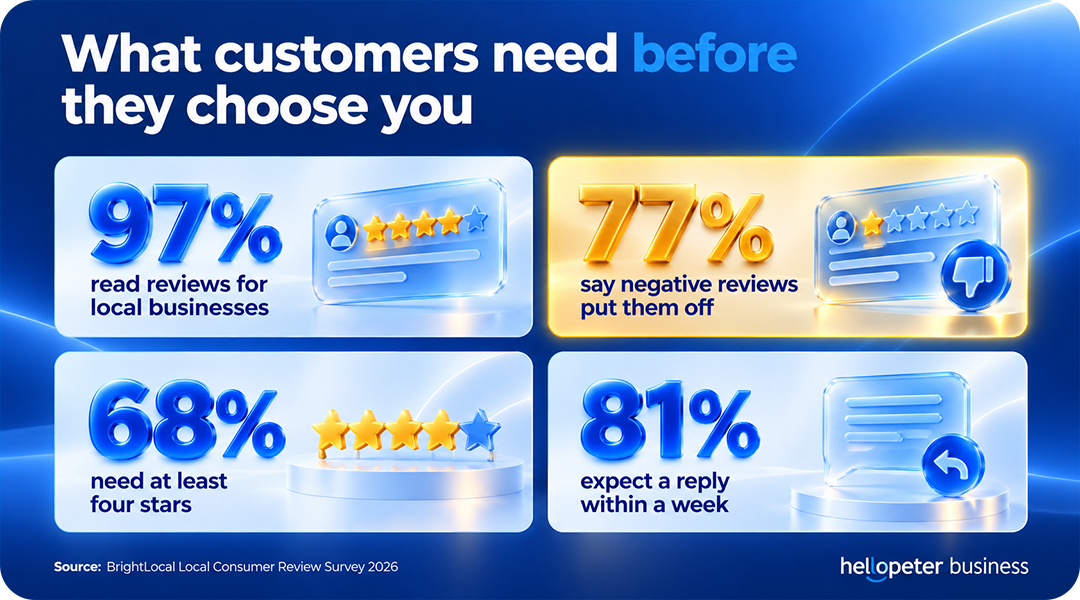
97% of consumers read reviews for local businesses, according to BrightLocal's 2026 survey. In South Africa, a lot of that reading happens on Hellopeter. More than 800,000 South Africans visit Hellopeter every month, and Hellopeter pages earn more than 500 million Google impressions a year. So when someone searches for your business, your reviews are often among the first things they see, before your website and before your team gets a chance to talk to them.
That's where the decision starts. By the time a customer contacts you, they've usually read what other customers say about you. The ones put off by what they read never contact you at all.
What a Bad Review Does to the Decision
Customers don't read a negative review and shrug. BrightLocal found that 77% say negative reviews make them less likely to choose a business. Most customers also have a cut-off: 68% need a business to have at least four stars, and 31% will only use a business rated 4.5 or higher.
Those thresholds are where the cost gets real. A rating that slips below four stars takes you off the shortlist for most of the people searching.
What It Does to Your Revenue
The best-known study of ratings and revenue comes from Harvard Business School: every extra star drives up to 9% more revenue. Run that in reverse, and the cost of a sliding rating is easy to picture. The stars you lose are revenue that never appears on a report, because the customers behind it quietly went elsewhere.
How much that adds up to depends on two things only you know: how many people look at your reviews, and what a customer is worth to you. That's why there's no honest single figure for what one bad review costs. Our free Reputation Report works it out for your business, starting from how many people see your Hellopeter page each month.
Silence Makes Every Number Worse
The damage from a negative review grows when nobody answers it. 89% of consumers expect business owners to respond to reviews, and 81% expect that reply within a week, according to BrightLocal. On Hellopeter, 69% of reviews get a reply, so an unanswered complaint stands out to every customer who reads it.
Silence shows up in your score too. Your TrustIndex weights every review by how fast you replied: a review answered within 8 hours counts in full, and one left unanswered counts at 70% of its value. We set out the full method, and what silence does to some of the country's biggest brands, in our article on why silence on public complaints damages your brand.
Your Reviews Now Travel Into AI Answers
Customers don't have to open a review site to be put off any more. Google's AI Overviews arrived in South Africa in late October 2024, and when people search for a business, the AI summary often describes its review reputation before anything else. In our April 2026 test, Google's AI opened its summary of Takealot with its Hellopeter TrustIndex, and called it a sign of poor overall customer satisfaction.
That summary reaches people who never click through to read a single review. So the cost of a negative review no longer stops at the people who visit your page. We look at what this shift means in zero-click search for South African businesses.
A Few Bad Reviews Aren't the Problem
There's good news in the numbers as well. Customers don't trust perfection. Research from the Spiegel Research Center at Northwestern University found that people are most likely to buy when a rating sits between 4.2 and 4.5 stars, because a perfect score looks too good to be true. A handful of negative reviews, answered well, makes the positive ones more believable.
What decides the cost is what happens after the complaint. One that's answered quickly, fairly and in public shows the next customer how you behave when something goes wrong. One that's left alone shows them as well. How to respond to negative reviews gives you the replies, and review response best practices turn them into a routine your team can keep.
How to Bring the Cost Down
- Reply to every review, quickly. Aim for the same day. Replies within 8 hours get the full weighting in your TrustIndex.
- Fix what customers keep complaining about. A reply rescues one customer's impression, and fixing the cause stops the next complaint. Hellopeter's AI analysis of customer feedback shows what your customers praise and complain about most, theme by theme.
- Keep fresh reviews coming. A steady flow of recent reviews from real South African customers stops one bad week from defining you. Collecting reviews on WhatsApp takes a customer about 60 seconds.
- Know your number. The free Reputation Report shows how many people see your page and where you're losing them.
A Note on This Data
The research figures in this article come from the studies named alongside them. The Hellopeter figures were accurate at the time of publication and are updated as new customer reviews come in. Hellopeter's scores are generated from real customer reviews, not set by Hellopeter or by the businesses themselves.
Work out what your reviews are costing you
Get a free report of what your reputation is worth, where you're losing customers, and what your reviews say about you.