Most businesses know their advertising spend to the cent. Very few can put a number on the thing that decides whether a customer chooses them: what people read about them before they get in touch. Our free Reputation Report puts a number on it. You answer three questions and get a report showing what your reviews are earning you, or costing you, in rand.
This article explains what goes into that report: what it measures, the one figure it estimates, and why we deliberately made that estimate small.
Everything else is measured. The single estimate assumes that just one in 200 people who read poor reviews about a business walks away, far below what published research suggests.
The Three Questions
The Reputation Report covers more than 37,000 South African businesses on Hellopeter. It asks:
- What is your business called? You pick it from the list. If it isn't listed, you can say so and still get a report.
- Roughly what is one new customer worth to your business in total? You choose one of five bands, from under R500 to over R50,000. We ask for a customer's whole spend, so every rand figure in the report is a lifetime value.
- Do you have a website, and how many people visit it each month? This one sharpens the numbers, and you can skip it.
What the Report Measures
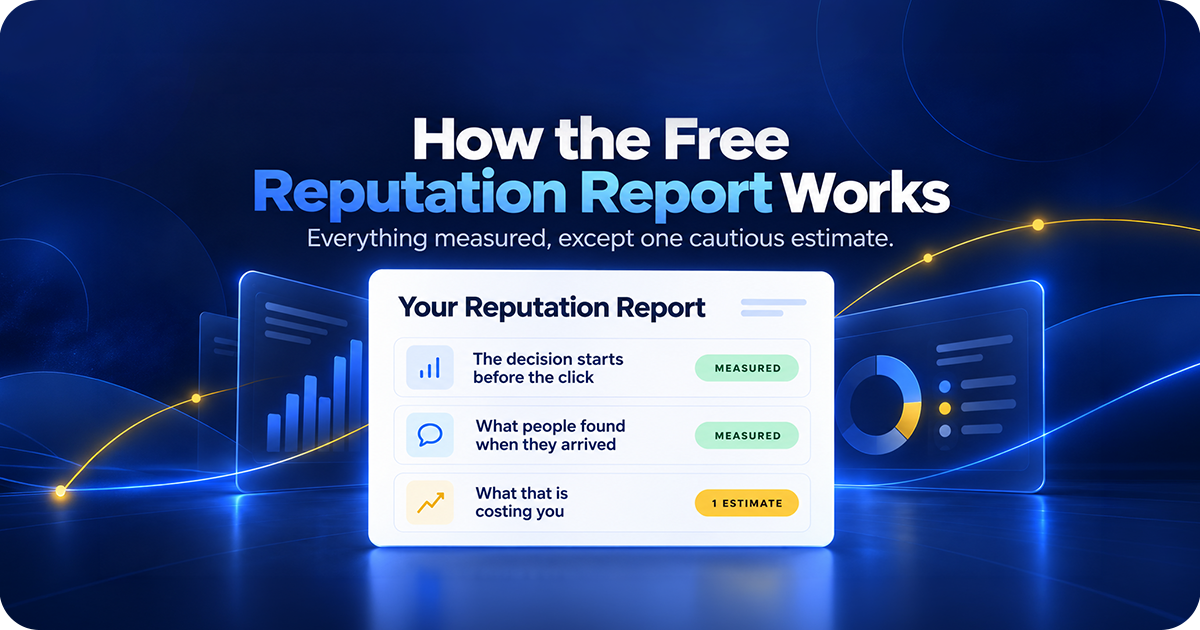
The report has three sections. The first two contain no estimates at all.
The decision starts before the click. How often Hellopeter listings in your industry appeared in Google last month, and how often yours was one of them. It also shows what a searcher could see without clicking: your star rating, and your TrustIndex and review count where you have them. Most buying decisions start here, on a search results page you don't control.
What people found when they arrived. How many people opened your Hellopeter profile and read your reviews last month, across every page of your profile and from every source, not only Google. How many of your reviews from the last year have no reply. And your weakest service theme, from Hellopeter's AI analysis of customer feedback.
What that is costing you. This is where the one estimate lives. If your rating is 4.0 or higher, the heading changes to What that is earning you, because a strong rating wins customers.
The One Estimate, and Why It's Deliberately Small
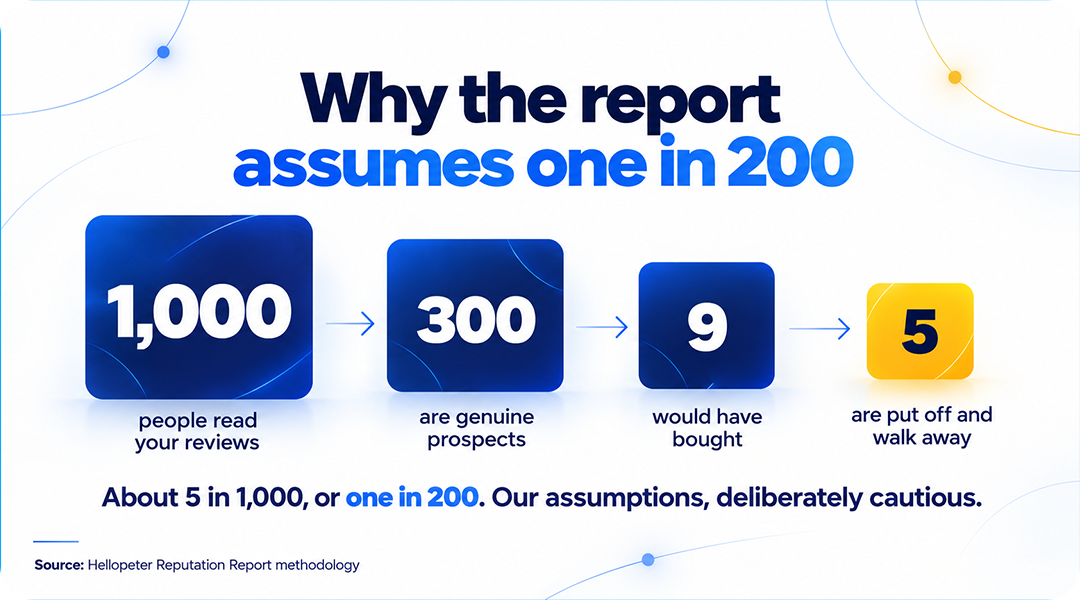
Everything in the first two sections is a measurement. The final figure is an estimate, and it rests on one assumption that's written into the sentence that uses it: of the people who read your reviews, one in 200 walks away. That's half of one percent. For a business that isn't on Hellopeter at all, so a searcher finds nothing to read, we use one in 100.
That number is small on purpose. Most people who look a business up were never going to buy from it. Some are existing customers checking on a complaint. Some are just curious. And many of those who are put off would have chosen a competitor anyway.
How We Arrived at One in 200
Our reasoning runs like this: roughly three in 10 of the people reading are genuine prospects, about three in 100 of those would have bought, and around six in 10 of those are put off by poor reviews. Multiply it through and you land just above half of one percent. A more generous reading of the same steps gives about 1.5%, so one in 200 sits at the cautious end.
The research behind that six in 10 is consistent. BrightLocal's 2026 Local Consumer Review Survey found that 97% of consumers read reviews for local businesses, and 77% say negative reviews make them less likely to choose a business. Harvard Business School research found that every extra star can bring up to 9% more revenue.
We take the people who read your reviews, or half of your website visitors if you gave us that number and it's larger, multiply by one in 200, then by the customer value you gave us. The result is a lifetime-value figure, labelled as an estimate. If the numbers are too small to produce at least one whole customer, the report says so rather than showing you a meaningless figure.
Where the Numbers Come From
- Google appearances and clicks come from Google's own Search Console data for Hellopeter. Google doesn't report every search individually, so these counts are a floor, which is why the report says "at least".
- Profile visitors come from Hellopeter's analytics and count people, not page views.
- Your rating, reviews, reply rate and theme scores come from the platform itself.
- The month the figures cover is stated on the report.
Nothing is invented to fill a gap. If a figure doesn't exist for your business, the sentence that needed it drops out, and the report asks for what would complete it, usually your website traffic.
What the Report Doesn't Do
It doesn't tell you what advertising would cost to buy the same exposure. What someone else would have paid isn't money your business earned, so we took that figure out. It doesn't claim audited losses or earnings: rand figures are estimates and are labelled that way.
See what your reputation is worth
Answer three questions and get a free report of what your reviews are earning or costing you, and where you're losing customers.
What to Do With Your Number
If your report says your reputation is costing you, the fix is the same three things every time: reply to your reviews, good and bad, so the next reader sees what happens when something goes wrong; fix the problem customers mention most, which is usually your weakest theme; and ask happy customers to review you, so the complaints aren't the only voices. Our guide to what negative reviews really cost goes deeper on each.
If your report says your reputation is earning you customers, protect it. A strong rating built on reviews nobody answers is weaker than it looks, and your competitors are reading the same page.