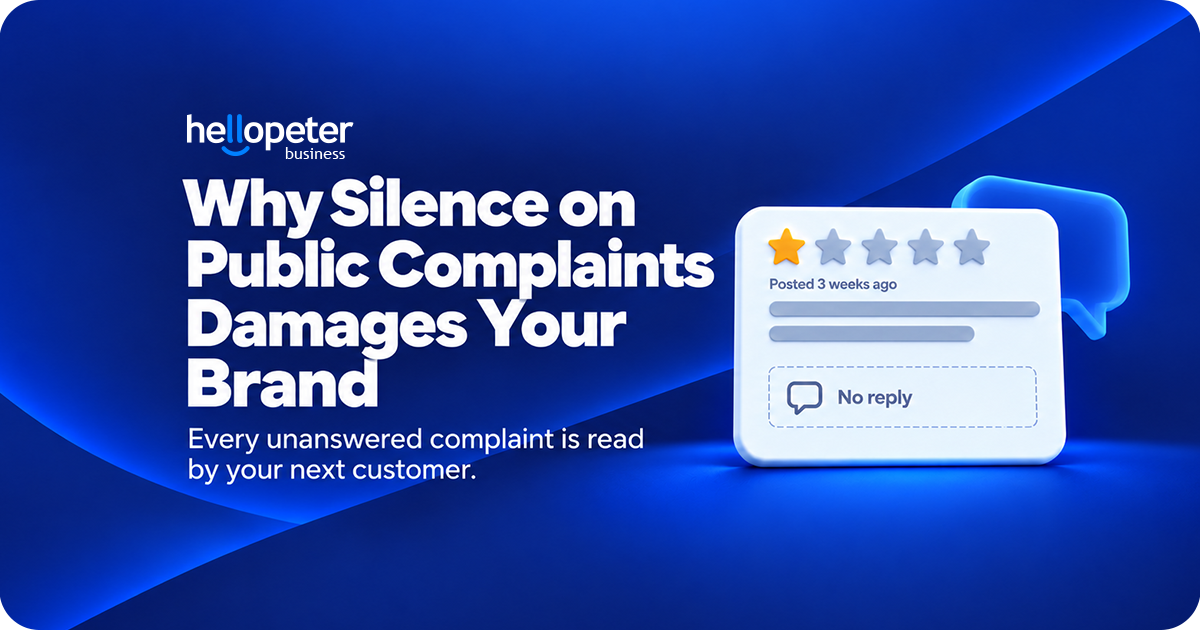
A customer posts a complaint about your business on Hellopeter. Maybe you sort it out on the phone. Or perhaps you decide it isn't worth engaging. Either way, you say nothing in public. The trouble with ignoring customer complaints in public is that the people deciding whether to trust you never see the phone call. They see the complaint, and the silence underneath it. On Hellopeter, the silence also goes into the maths behind the score that Google and AI assistants quote about South African businesses.
A review you answer within 8 hours counts in full. Leave it unanswered, and it counts at 70% of its value, every time it's used to calculate your score.
What Your Silence Tells Your Customers
Every unanswered complaint speaks to three audiences at once.
- The customer who complained hears that their problem wasn't worth a reply. Even if you fixed it privately, nothing on the record says so.
- The next customer checking you out sees what happens when something goes wrong with you. This is the most important reader, and there are far more of them than there are complainants.
- Your existing customers start to wonder whether they should be worried.
Your customers expect better. 81% of consumers expect a reply to a review within a week, according to BrightLocal's 2026 research. On average, 69% of reviews on Hellopeter get a reply. So an unanswered complaint stands out: most reviews on the platform get an answer.
Silence Is Built Into Your TrustIndex
Your TrustIndex is Hellopeter's trust score out of 10, and it's the number Google's AI summaries and AI assistants have been quoting when South Africans ask about local businesses. It's worked out from four things: the star rating on each review, how quickly you reply, a small allowance that stops new businesses being ranked unfairly, and only the reviews from the last 12 months.
The reply part is simple. Every review is weighted by how fast you answered it:
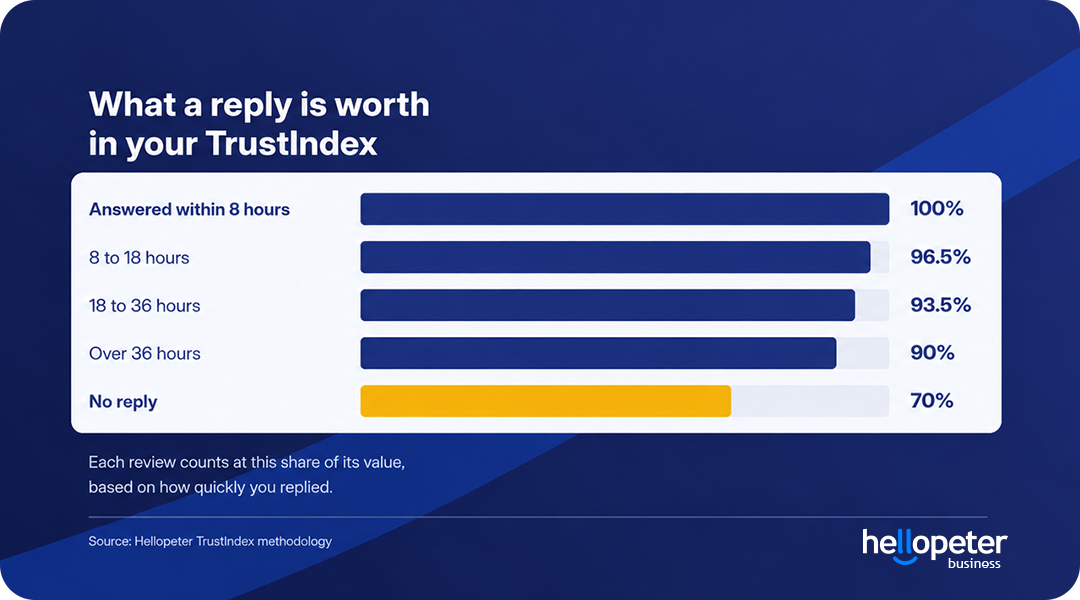
There's a bonus for consistency too. If you have more than 30 reviews and more than 67% of your replies go out within 8 hours, your final score gets an upward adjustment. The full method is set out in how TrustIndex is calculated.
Answering a bad review doesn't erase it, but an answered review always counts for more than an ignored one. The formula rewards what your customers reward: showing up.
The Brands That Go Quiet, and the Ones That Don't
Here's what that looks like on real profiles today.
| Feature | Hellopeter | Google Reviews |
|---|---|---|
| OUTsurance | All negatives, about an hour | 10 |
| Gys Pitzer Motoring | All negatives, under six hours | 10 |
| Mobicred | 92% of negative reviews | 7 |
| Takealot | No replies | 2.2 |
| Nedbank | No replies | 1.7 |
| DStv | No replies | 1.7 |
| MTN | No replies | 1.6 |
| Telkom | No replies | 1.6 |
To be clear about what drives that gap: star ratings do most of the work. MTN, Telkom and DStv get a lot of one-star reviews, and replying wouldn't turn those into five-star ones. But silence locks the damage in.
Every one of those unanswered reviews counts at 70%, and nothing on the page tells the next customer that anyone is listening. When Google's AI summarised the reputation of Takealot in our April 2026 test, it opened with the TrustIndex. That's the number your silence feeds.
Compare OUTsurance, which replies to every negative review in about an hour, or Gys Pitzer Motoring, which answers within hours and has held a 10 out of 10 for a long stretch. Both get complaints like any busy business. The difference is how fast they answer them.
Why Handling It Privately Isn't Enough
The most common reason businesses stay quiet is a good instinct used the wrong way: "we'll deal with it directly with the customer." Resolving privately is right. However, keeping the resolution private is the mistake, because the readers deciding whether to trust you can't see it.
The fix takes three short steps:
- Acknowledge feedback in public. Thank the customer, show you understand, and invite them to a private channel with their reference number.
- Resolve in private. Protect their personal information and sort it out properly.
- Close the loop in public. Once it's fixed, say so in one line. That's the reply future customers remember.
Our guide on how to respond to negative reviews has templates for each step, and review response best practices turn them into a routine your team can keep. If a complaint is spreading fast, start with the 48-hour viral complaint playbook.
Replying Is Where It Starts
A reply shows you care. What retains customers is fixing the reason they complained, and that means knowing where things go wrong. Your rating tells you the score, not the story. We tell you why.
For businesses with enough reviews, Hellopeter's AI analysis of customer feedback shows what your customers praise and what they complain about most, theme by theme, against your industry, and you can compare your AI scores against up to five competitors on the platform.
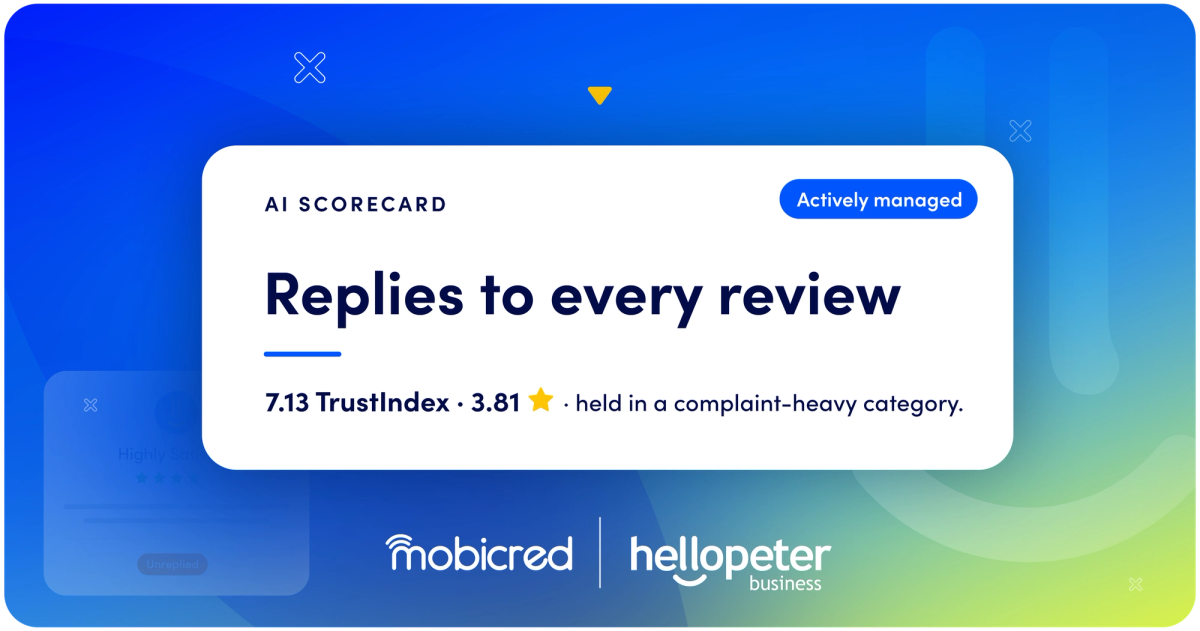
Mobicred is a good example of how far that can go. Its rating had sunk to 1.4 stars before it started replying to its reviews, the angry ones included, and working on what they said. Today it replies to 92% of negative reviews and sits at a TrustIndex of 7. Read how Mobicred took control of its reputation.
Silence is a choice your customers can see. And so is showing up.
A Note on This Data
The Hellopeter figures in this article were accurate at the time of publication and update automatically as new customer reviews come in. Hellopeter's scores are generated from real customer reviews, not set by Hellopeter or by the businesses themselves.
See what your silence is costing
Get a free report of what your reputation is worth, where you're losing customers, and what your reviews say about you.