It usually starts with a screenshot. A customer posts about a bad experience in a big South African Facebook group, or on MyBroadband, or on X, and it spreads. By the time someone forwards it to you, hundreds of people have seen it, and a few are tagging your brand asking if it's true. The next few hours matter more than the complaint itself, because what the public remembers isn't that you got a complaint. It's how you handled it.
This is the calm, proven playbook. It works because it's built on a simple truth: a complaint that's answered well builds more trust than a clean profile with no complaints at all.
Every strong reputation still attracts complaints. What sets the leaders apart is they reply to every one, in public. The unanswered complaint is the version of the story that gets repeated.
First, What NOT to Do
In the first hour, the instinct to make it go away is exactly the instinct to resist:
- Don't delete it. Deleting a complaint, or trying to, is the single fastest way to make it bigger. Screenshots already exist, and "they deleted my post" is a worse story than the original.
- Don't ignore it. Silence reads as guilt. It also leaves the complainant's version as the only version on the record.
- Don't argue in public. You won't win a comment thread, and every reply you write defending yourself is more content for the algorithm to spread.
- Don't go private-only. Resolving it quietly in DMs is good, but if the public thread ends with no visible response, everyone assumes you did nothing.
The Playbook: Respond Fast, in Public, Then Resolve
Work through these in order. Most viral complaints are contained within a day when you do.
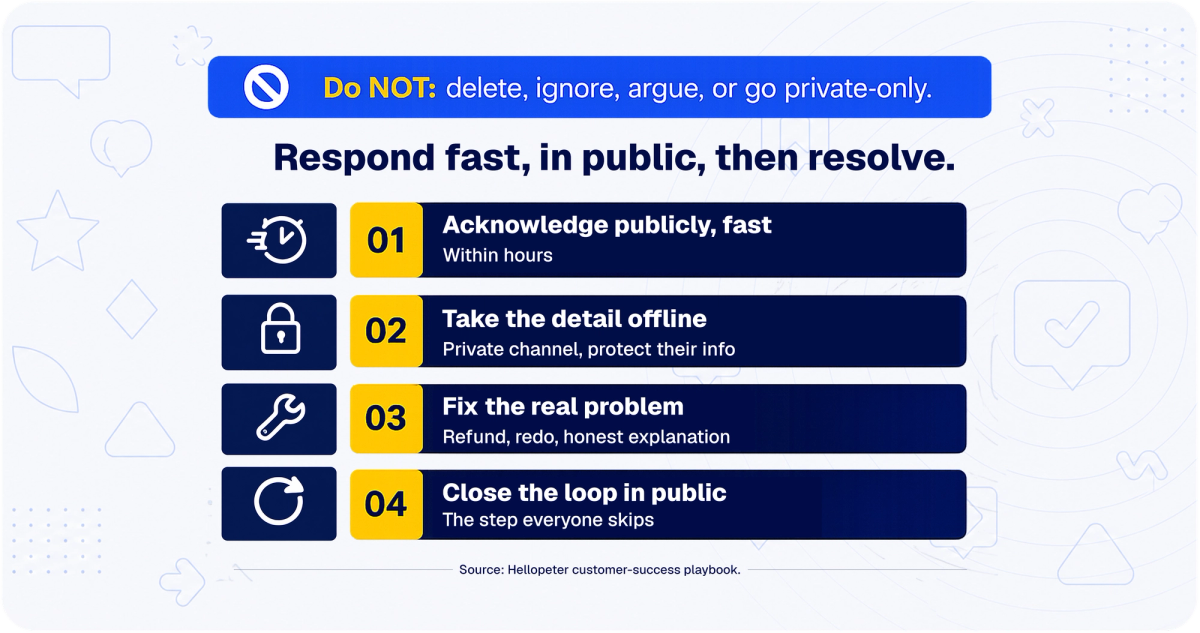
- Acknowledge publicly, fast. Reply on the same thread, and on your Hellopeter Business profile, within 24 hours. Be human: thank them for flagging it, say you're looking into it, and that you want to make it right. Speed matters more than perfection.
- Take the detail offline. Ask for their reference or order number via a private channel so you can actually investigate. This protects their personal information and stops the public thread becoming a back-and-forth.
- Fix the real problem. Resolve the underlying issue, not just the post. A refund, a redo, an honest explanation. This is the part the playbook can't fake.
- Close the loop in public. Once resolved, post a short, factual update on the original thread and your profile: what happened, what you did. This is the step almost everyone skips, and it's the one that turns a crisis into proof you can be trusted.
Why the Public Record Matters More Than Ever
A viral complaint used to fade when the thread went quiet. It doesn't any more. The complaint, and your response or your silence, lives on as part of what the next customer reads. And it's no longer only people reading it. When someone Googles your brand, Google's AI summarises your reputation, and it leans on the public record of how you handle complaints. An unresolved, unanswered complaint isn't a bad day. It's a line in the answer the machine gives about you for months.
That's also the opportunity. A complaint you handle visibly and well becomes evidence, to customers and to the AI, that you're a business that puts things right.
How to Be Ready Before It Happens
The businesses that handle viral complaints calmly are the ones that were already managing reputation as a habit, not a fire drill. That means watching your profiles so you hear about a complaint early, replying to every review as standard, and having a simple, agreed tone for responses so nobody freezes at 9pm. Hellopeter gives you the alerts, the single place to respond at scale, and the public record that proves you showed up. The goal is that a viral complaint is just a louder version of something you already do every day.
What is this costing you?
A complaint like this has a rand cost. Get a free report on what your reputation is worth, and what staying silent loses you.