




Hellopeter
South African consumers are more sceptical than they’ve ever been. Years of inflated claims, fake testimonials, and businesses that disappear after taking a deposit have created a trust deficit that no amount of paid advertising can overcome.
For the businesses that remain standing and competing for attention, one question now defines their growth trajectory: how do you prove you’re trustworthy when every competitor claims the same thing?
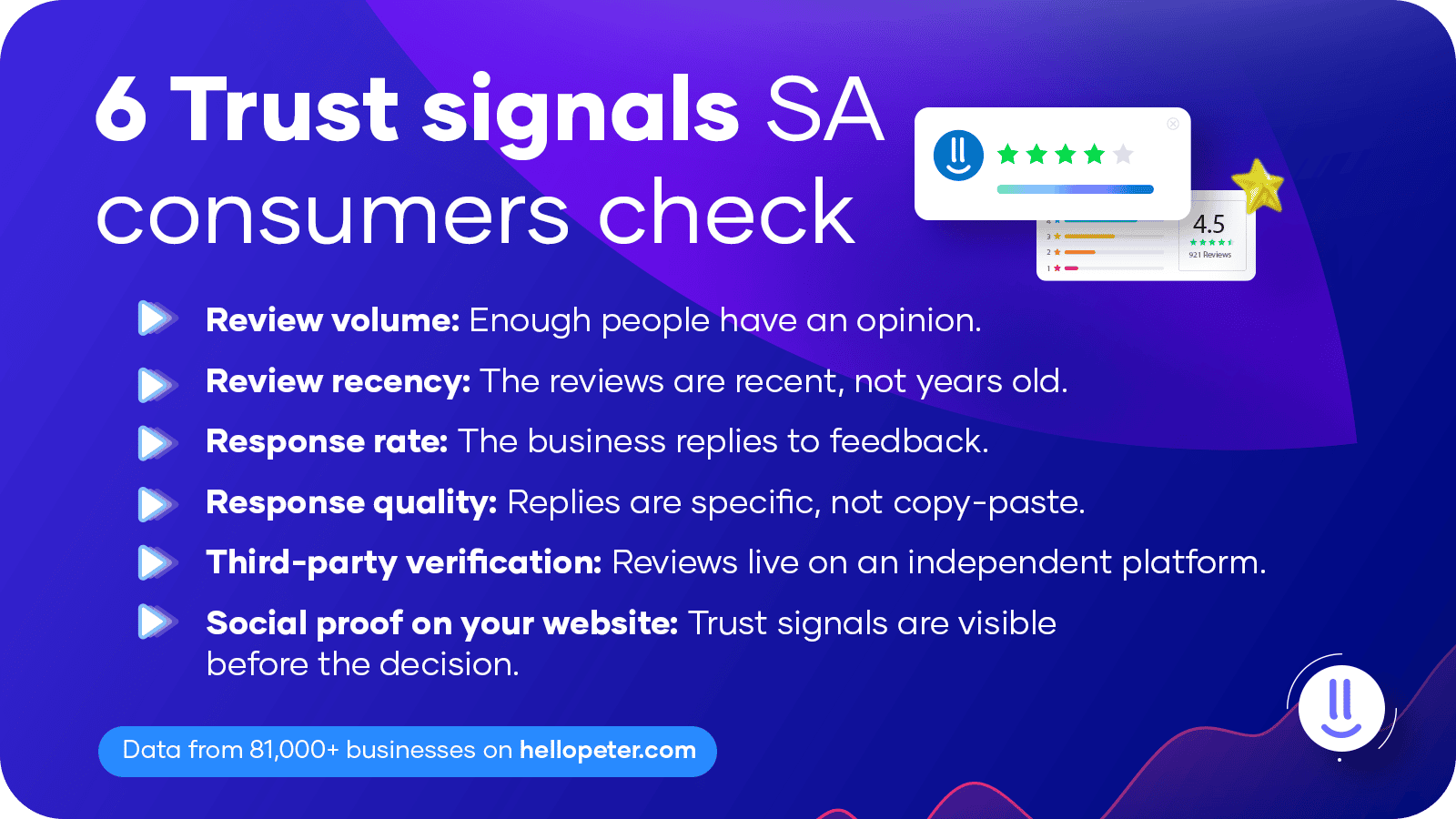
Signal 1: Review Volume: Do Enough People Have an Opinion?
A business with two reviews is not trustworthy. It’s unknown. Consumers interpret low review volume as a warning sign: either the business is too new, too small, or too few people have felt strongly enough to leave feedback. None of those interpretations build confidence.
The threshold varies by industry, but the pattern is consistent: consumers want to see enough reviews to form a reliable picture. A restaurant with 15 reviews tells a different story than one with 150. A financial services provider with three reviews raises questions that one with 80 does not.
For businesses, the implication is clear. Review collection cannot be passive. It must be an active, ongoing part of the customer journey that’s built into post-service workflows, not left to chance.
Signal 2: Review Recency: Is This Still True?
Consumers are time-sensitive in their trust evaluations. A business with glowing reviews from 2022 is not reassuring in 2026. Consumers ask: is this business still good, or did something change? Staff turnover, ownership changes, and declining service quality are all real possibilities that consumers instinctively account for.
The most trusted businesses on Hellopeter have a steady stream of recent reviews, ideally from the past 30 to 90 days. This recency signal tells consumers that the business is active, that other people are still using it, and that the quality they see in the reviews is likely to be the quality they experience themselves.
Signal 3: Response Rate: Does This Business Actually Care?
Consumers do not just read reviews. They read what happens after the review. A business that responds to every review, both positive and negative, sends a clear message: we are listening, we care, and we will act.
A business that ignores negative reviews sends an equally clear message: we either do not know, do not care, or cannot fix the problem. None of those conclusions help conversion.
The current average reply rate on Hellopeter sits at around 62%. Businesses that exceed that benchmark immediately stand out. Businesses that consistently hit 90%+ occupy a trust tier that most competitors have not reached.
Signal 4: Response Quality: Is This a Real Human Being?
A templated response is better than no response, but it’s not much better. Consumers can spot a copy-paste reply instantly, and it undermines the trust signal that responding is supposed to create.
The responses that build trust are specific: they reference the customer’s experience, acknowledge the issue, explain what has been done, and offer to continue the conversation. They read like a real person wrote them… because a real person did.
Signal 5: Third-Party Verification: Can I Check This Independently?
Consumers have learned to distrust testimonials on a business’s own website. They know those are curated, filtered, and potentially fabricated. What they trust is feedback on independent, third-party review platforms where the business cannot delete or suppress negative reviews.
This is precisely why a strong Hellopeter profile carries more weight than a testimonials page. The reviews are independently verified, publicly visible, and include both positive and negative feedback. The business cannot remove a bad review; they can only respond to it. That constraint is exactly what makes the platform trustworthy to consumers.
Signal 6: Social Proof on Your Own Website
Hellopeter’s TrustIndex is a composite score that combines review volume, recency, sentiment, and response behaviour into a single, publicly visible metric. For consumers, it offers an at-a-glance answer to the question: Should I trust this business?
For businesses, TrustIndex is a competitive benchmark. It tells you not just where you stand, but where you stand relative to others in your industry. Businesses with higher TrustIndex scores consistently outperform competitors on conversion metrics because trust reduces the friction between consideration and purchase.
What This Means for Your Business
Every one of these signals is within your control. You can:
Build review volume through systematic collection
Maintain recency by making review requests a post-service standard
Improve response rates and quality by assigning ownership and setting standards. Display your trust signals with review widgets
Build all of this on a platform where the verification is independent and the data is public
The businesses that understand this are already doing it. The question is whether your business will join them, or continue losing customers to those who have.
Read more:
How South African Businesses Can Build Real Trust Online in 2026
See how your business scores on every trust signal. Start your free 14-day Hellopeter Business trial. |
RELATED ARTICLES
How to Request a Review Update: From Complaint to Resolved

Why Black Friday Customer Experience Beats The Discounts

How Super Communications Got to Rank #1 in 3 Industries on Hellopeter
UP NEXT
7 THINGS CUSTOMERS CHECK ONLINE BEFORE BUYING FROM YOU THIS BLACK FRIDAY