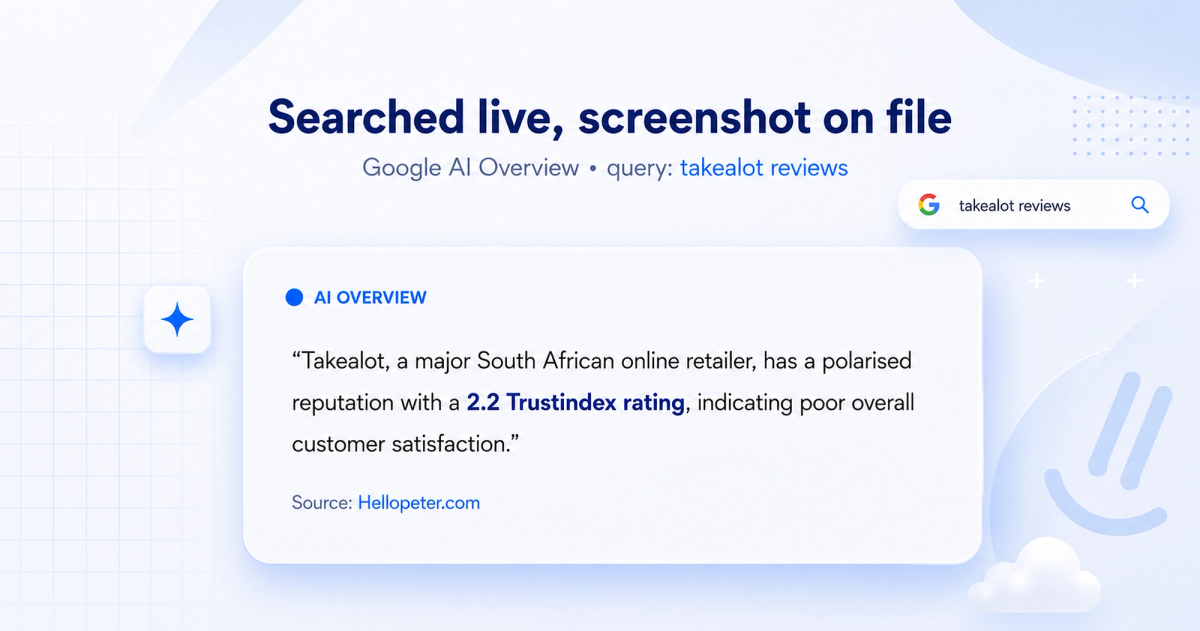
Type takealot reviews into Google from anywhere in South Africa. Before the first blue link, Google's own AI summary opens with a number it didn't invent:
"Takealot, a major South African online retailer, has a polarised reputation with a 2.2 TrustIndex rating, indicating poor overall customer satisfaction."
That "TrustIndex" is Hellopeter's. Google isn't linking to us. It's quoting us, the way it quotes a temperature or an exchange rate: as a fact. And the only reason that number carries weight is that it's the verdict of real South African customers. Google is repeating what your customers said, and it's reading it on Hellopeter.
This is the most important shift in South African brand reputation in a decade, and it didn't happen by accident. It happened because of what sits underneath that number.
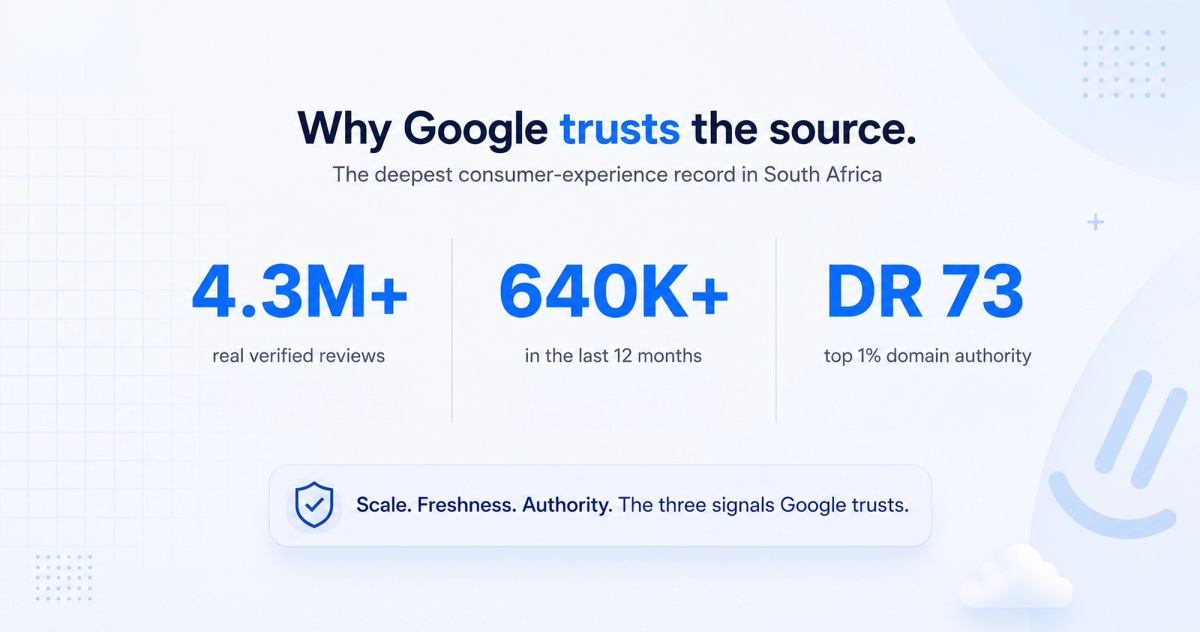
4.3 million+ real reviews from real South African customers, the deepest consumer-experience record in the country.
The Scale Google Is Reading
Google's AI doesn't lean on a source because it's loud. It leans on a source because it's deep, recent, and authoritative. On every one of those measures, Hellopeter stands alone in this market:
- 4.3 million+ real reviews from real South Africans, verified by mobile number.
- 640,000+ reviews in the last 12 months alone, the recent, recency-weighted record that AI search leans on most.
- 500 million+ Google impressions a year from Hellopeter profiles.
- Ahrefs Domain Rating 73, the top 1% of all domains globally for authority.
- 25 years as South Africa's consumer trust platform. No one else has the depth.
- Thousands of South African businesses now AI-analysed across 40+ industries.
That depth is why Google's AI treats Hellopeter as a primary source for South African brand reputation. There's no second platform with this footprint in this country.
Proof, in Google's Own Words
These aren't our claims about ourselves. They're Google's AI Overview, searched live from a South African connection, with screenshots on file. Anyone can replicate them.
"Discovery Health... with a 2.5 to 2.6 out of 5 TrustIndex on Hellopeter.com." (Google AI Overview,
discovery health reviews)
"FNB generally maintains a low TrustIndex, with many consumers reporting negative experiences (roughly 3.1)." (Google AI Overview,
fnb reviews)
"...leading to very low ratings on platforms like Hellopeter (e.g., 1.5 out of 5)." (Google AI Overview,
webafrica reviews)
"DStv (MultiChoice) Reviews | 1.7 TrustIndex | Hellopeter.com" (Google AI Overview,
dstv reviews)
The pattern is unmistakable, and it holds across the overwhelming majority of South African brand-reputation searches: banking, insurance, retail, telecoms, medical aid, ISPs and more. Google uses "TrustIndex" the way it uses a star rating, as a quotable unit. That's editorial adoption, not a citation, and it's far stronger than any backlink.
And It Is Not Only Google
The same thing is happening across AI search. Ask ChatGPT, Claude or Gemini about a South African brand and they reach for Hellopeter as the reference point, "according to Hellopeter," "based on Hellopeter reviews," and they frequently quote the TrustIndex itself.
That's the deeper shift. Whether a South African asks Google, or asks an AI assistant directly, the trusted answer about a local brand is grounded in Hellopeter. We're becoming the reference layer underneath AI's answer about South African business reputation, on every engine that matters.
The Dual Moat
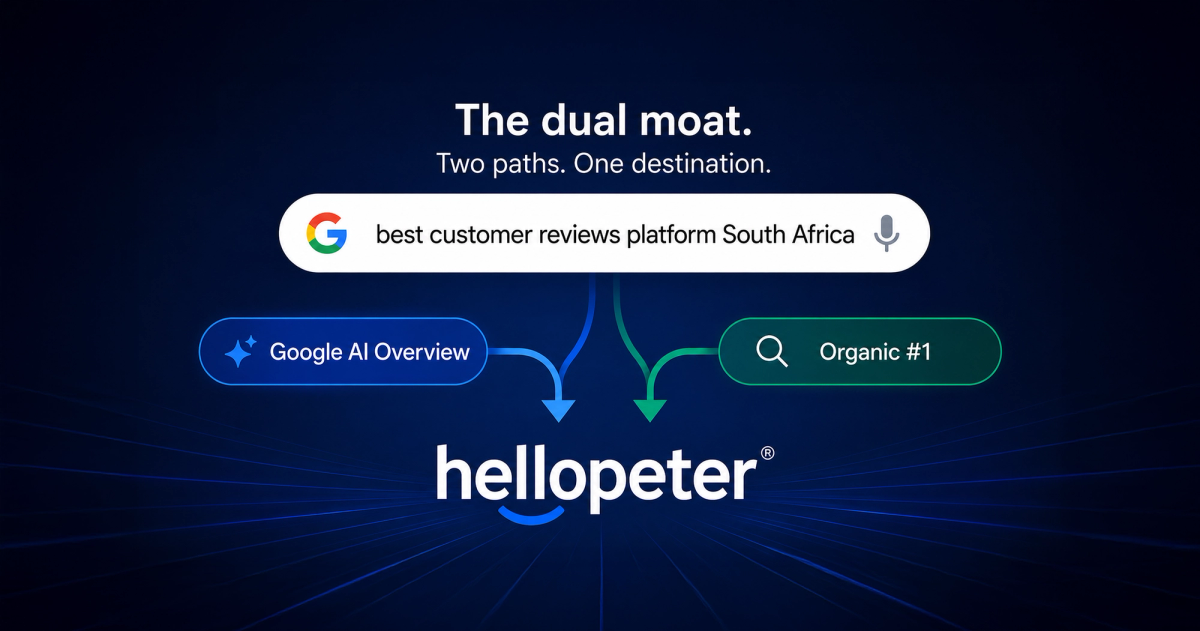
When a South African Googles a brand's reputation, Google answers in one of two ways. Either way, the answer is Hellopeter.
- The AI Overview path. Where Google generates an AI summary, Hellopeter is cited as the source, often with the TrustIndex quoted as a number.
- The organic path. Where Google runs no AI summary, for floor-rated brands, or plain navigational searches, Hellopeter holds organic position #1.
There's no South African review platform that appears reliably in both layers. Trustpilot turns up occasionally as a peer, never as the dominant source across sectors. For practical purposes, when South Africa Googles a brand's reputation, it's reading Hellopeter.
What We Have Just Made Bigger
Here's the part that matters most for every South African brand. We've just given Google, and every AI engine, far more to read.
Until now, the signal was mostly the star rating and the TrustIndex. As of launch, every qualifying Hellopeter profile carries a new layer, built by AI reading the actual content of customer reviews, not just counting stars. All of it's structured and server-rendered, which is exactly what makes it readable by Google and by AI assistants:
- AI Review Summaries: a plain-language summary of the specific, recurring themes in a brand's reviews.
- Service Quality Ratings: separate theme scores per industry, so a brand is measured on the things that actually matter in its sector.
- Overall AI Score: a single composite per business, with the category leader named.
- Industry AI Summaries: sector-wide analysis across banking, insurance, retail, telecoms, healthcare, automotive and more.
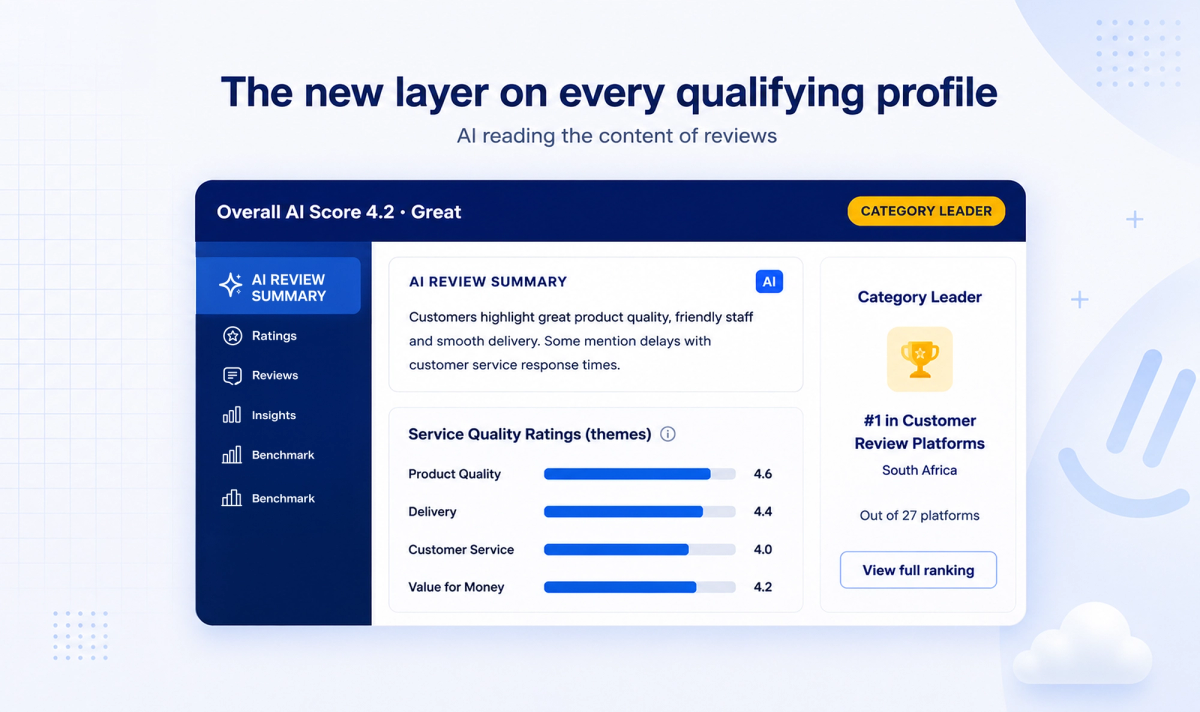
The category-leader designations are the sharpest new surface. They name the best business in a category, on a public page, ready for Google to quote when a consumer asks "best insurance in South Africa." A year ago, establishing that took a full case study. Now it's live on the profile and the industry page.
What It Looks Like, in Insurance
Take insurance. The Service Quality Ratings break the category into the five things customers actually judge an insurer on: Claims Handling, Communication, Agent Quality, Pricing and Repair Quality. Each theme carries an industry average and a single Best-in-Class business named on the page.
So a consumer no longer sees only "who has the most stars." They see who is best at the moment that decides everything in insurance: paying a claim. And because it's structured and public, that's exactly what Google's AI reaches for when someone asks which insurer to trust. The brand that's genuinely best at claims now has that recognised, named, and quotable, without ever writing a word of marketing.
What This Means for Your Brand
If your reputation is bleeding (a low TrustIndex, and you aren't yet a customer): that number is being repeated into every Google AI answer about you, and quoted by AI assistants too. Every prospect researching you sees it first, as a stated fact. It reflects what your customers are experiencing, and the tools to understand it, respond to it, and turn it around are on the Hellopeter business platform.
If you already pay for Hellopeter but your rating is low: you're no longer only managing your reputation with customers. You're managing the number Google and AI search are quoting about you to every prospect. You're the one business in that position with the platform, the data, and the tools to move it, and you're already paying for them. The opportunity is to use them deliberately.
If You Are a Smaller Brand, This Is Reach You Can't Build Alone
A small or growing business can't realistically build what sits behind these answers on its own. A Domain Rating of 73, 500 million+ Google impressions a year, a trusted-source position inside Google's AI and across ChatGPT, Claude and Gemini: that took 25 years and millions of real reviews. You can't buy it, and you can't shortcut it.
But you can borrow it. Collecting the reviews that power it takes almost nothing from you: your customer leaves a verified review in seconds, straight from a WhatsApp message, on the app they already live in.
How Your Reputation Travels
From there, your reputation rides on Hellopeter's authority: into Google's organic results, into Google's AI Overview, into the answers AI assistants give about you, and into your Google Business Profile, where Hellopeter increasingly appears in the panel a customer sees the moment they search your name. The search and AI heavy lifting your own website could never do, Hellopeter does for you.
This is already happening to brands far smaller than the household names. A specialist furniture manufacturer in Cape Town, for instance, has a Google Business Profile that pulls Hellopeter in as its main "Reviews from the web" source: a strong score from over a hundred verified customers, shown right alongside another review platform carrying only a handful of votes. The manufacturer didn't build that placement. Google chose Hellopeter as the credible source, because the reviews are real and the platform is trusted.
For a smaller brand deciding where to spend a limited marketing budget, that's the rare channel that compounds. Every real review you collect makes you more discoverable, more credible, and more quotable, on the exact surfaces where South Africans now decide who to trust. It's not advertising you rent for a month. It's reputation you own, carried by the platform that, for 25 years, has been synonymous with reputation and trust in South Africa.
The Bottom Line: AI Search Is the New Front Door
The way South Africans discover and judge brands is moving from ten blue links to a single AI answer, on Google and on every assistant. The brands that win that moment are the ones whose real customers have good things to say in public, where the AI can read them. Clever marketing matters far less than what those customers actually report.
Hellopeter spent 25 years building exactly that record. When Google or an AI assistant tells a South African about a brand, it's telling them what that brand's customers have said, on Hellopeter.
So the question for every brand is no longer whether you're on Hellopeter. You are, and so are your customers' words. The question is whether you're listening to what they're saying, and acting on it, while it's being read aloud to the entire market.