




Hellopeter
Understanding why online reputation matters as a business risk is one thing. Seeing how systematic reputation management actually works in practice with real challenges, real implementation decisions, and real measurable outcomes is another.
This case study examines how a mid-sized South African business transformed their approach to customer complaints, moving from reactive silence to systematic public engagement. The results demonstrate that reputation management isn't just theoretical risk mitigation it's a measurable driver of business performance improvement.
While the specific company name and identifying details have been anonymized to protect client confidentiality, the challenges they faced, the strategies they implemented, and the outcomes they achieved are representative of what's possible when businesses treat online reputation as a strategic business risk requiring systematic management.
This case study explores the initial situation and challenges, the strategic decisions made during implementation, the operational changes required, the resistance encountered and overcome, and the measurable business outcomes achieved over 18 months.
Company Profile and Initial Situation
Business Overview
The business profiled in this case study operates in the professional services sector, serving both B2B and B2C customers in the South African market.
Company profile:
- Industry: Professional services (telecommunications sector)
- Annual revenue: R180 million
- Customer base: Mix of enterprise contracts (40% of revenue) and consumer customers (60% of revenue)
- Market position: Mid-tier competitor in competitive market
- Geographic focus: Major South African metros
- Team size: 320 employees, including 45-person customer service team
Initial Reputation Situation
When the company first engaged with systematic reputation management, their online reputation presented significant challenges:
Hellopeter profile metrics (baseline):
- Total reviews: 234 (accumulated over 3 years)
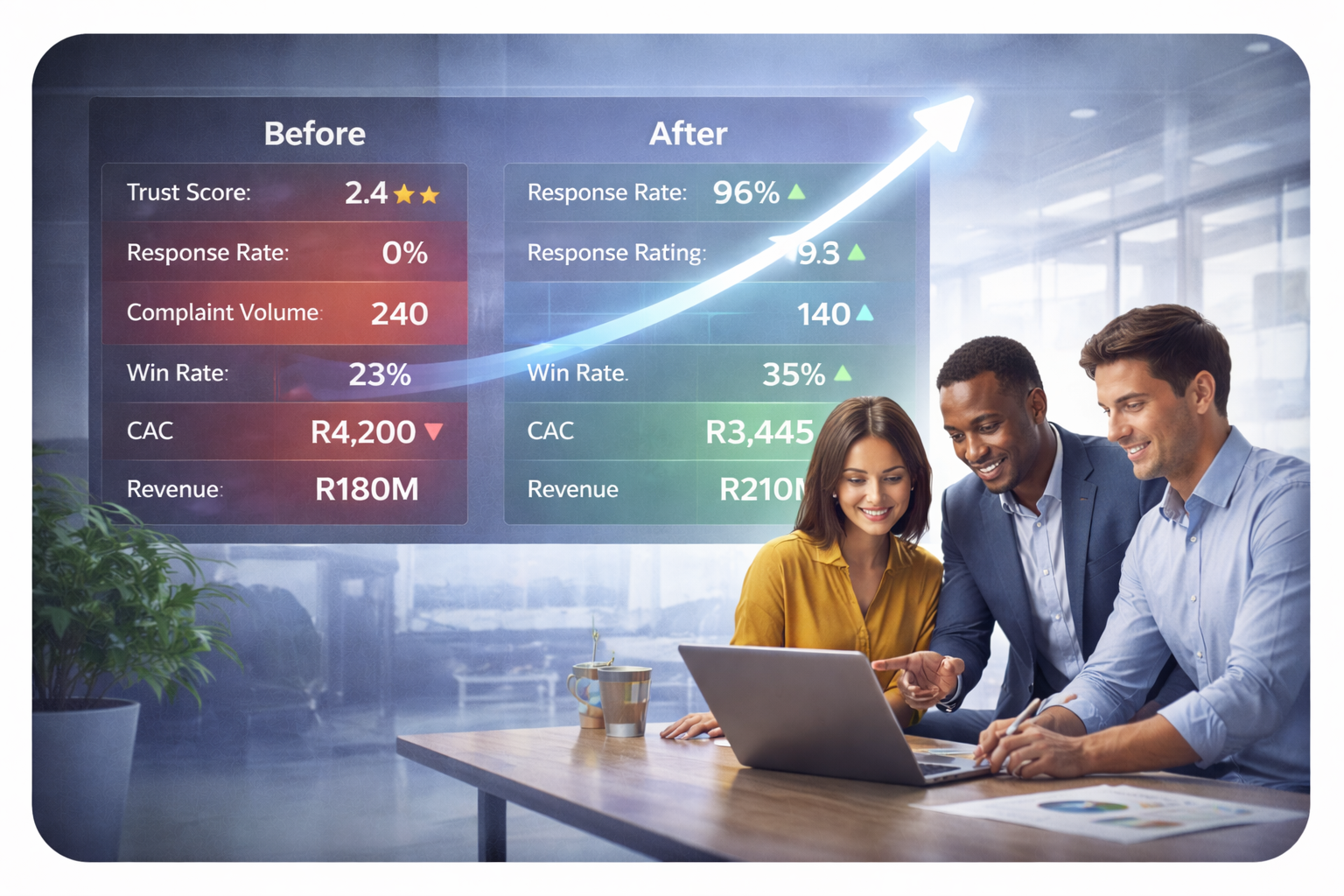
- Average rating: 2.4 stars out of 5
- Negative reviews: 186 (79% of total)
- Company response rate: 0% (complete silence on all complaints)
- Resolution rate: Not tracked (no follow-up on public complaints)
Complaint pattern analysis: Common themes in negative reviews included:
- Service activation delays (mentioned in 42% of complaints)
- Billing errors and disputes (38% of complaints)
- Poor customer service responsiveness (51% of complaints)
- Technical support quality issues (29% of complaints)
Competitive comparison:
- Main competitor average rating: 4.2 stars
- Industry average: 3.7 stars
- Company position: Significantly below both competitor and industry averages
Business Performance Context
The reputation situation existed alongside concerning business performance trends:
Key business metrics (12-month trend):
- Revenue growth: Declining from 12% to 5% year-over-year
- Customer acquisition cost: Increased 32% over 12 months
- Sales cycle length: Extended from 45 days to 62 days average
- Enterprise deal win rate: Declined from 31% to 23%
- Customer churn rate: Increased from 8% to 13% annually
- Net Promoter Score: -12 (concerning territory)
Sales team feedback: Consistent patterns emerged from sales team reports:
- "Prospects are mentioning negative reviews during sales calls"
- "We're losing enterprise deals in final procurement stages"
- "Reference requests have tripled compared to last year"
- "Price negotiations are more aggressive everyone wants discounts"
- "Competitors are highlighting their better customer satisfaction in RFPs"
Customer success observations: The customer success team reported:
- Existing customers mentioning negative reviews during renewal discussions
- Increased support ticket volume suggesting service quality concerns
- More difficult upsell conversations
- Defensive posture from customers who'd seen public complaints
While leadership couldn't definitively attribute all performance deterioration to reputation, the correlation between visible complaint patterns and business friction was increasingly difficult to ignore.
The Decision Point: Recognizing Reputation as Business Risk
The company reached a critical decision point when a major enterprise opportunity was lost explicitly due to reputation concerns.
The Catalyst Incident
A R12 million, 3-year enterprise contract opportunity progressed through the entire sales cycle:
- Successful initial presentation and technical demonstration
- Positive reference calls with existing enterprise customers
- Favorable pricing compared to competitors
- Strong internal champion at prospect company
In final procurement committee review, the deal was rejected. Post-decision feedback from the internal champion revealed:
"The procurement team conducted reputation due diligence and found significant patterns of customer service complaints on Hellopeter with zero company responses. The risk committee concluded this indicated systematic operational issues and governance gaps. They couldn't justify selecting a vendor with such visible accountability problems for a mission-critical service contract."
This single lost deal directly attributed to public reputation issues represented 6.7% of annual revenue. The visible financial impact made reputation impossible to dismiss as merely a "marketing perception issue."
Executive Assessment
Following this catalyst event, the executive team conducted a systematic assessment of whether negative reviews were actually hurting the business:
Analysis revealed:
Conversion impact:
- Website visitor-to-inquiry conversion declined 28% over 18 months
- Correlation analysis showed decline accelerated as negative reviews accumulated
- No other significant variables (pricing, product, marketing spend) changed proportionally
CAC increase:
- Customer acquisition cost increased 32% while marketing spend increased only 8%
- Efficiency loss couldn't be explained by market factors alone
- Sales team reporting increased effort required per closed deal
Sales velocity:
- Sales cycles extended 38% (from 45 to 62 days average)
- Extension concentrated in final decision stages (due diligence, procurement approval)
- Pattern consistent with reputation-driven risk concerns delaying decisions
Win rate decline:
- Competitive win rate declined from 31% to 23%
- Lost deal analysis showed 40% explicitly mentioned service or reputation concerns
- Pattern particularly pronounced in enterprise segment (higher due diligence)
Financial impact estimation: Conservative calculation of annual cost from reputation damage:
- Conversion leakage: R8.2 million lost revenue
- CAC increase: R3.4 million excess acquisition cost
- Sales cycle extension: R2.1 million productivity loss
- Win rate decline: R4.8 million lost opportunities
Total estimated impact: R18.5 million annually (10.3% of revenue)
This financial quantification transformed the discussion from "should we do something about online complaints?" to "how quickly can we implement systematic reputation management?"
Strategic Decision
Based on analysis, leadership committed to:
- Treating reputation as material business risk requiring systematic management
- Implementing public engagement protocols on Hellopeter and other platforms
- Investing in operational improvements to address root causes of complaints
- Measuring reputation management as business performance initiative, not marketing campaign
Investment approved: R850,000 annually for systematic reputation management program.
Implementation Strategy and Execution
The company's implementation followed a phased approach over 18 months.
Phase 1: Foundation and Quick Wins (Months 1-3)
Objective: Establish basic monitoring and response capability while addressing most egregious complaints.
Actions taken:
Monitoring setup:
- Implemented Hellopeter for Business platform for centralized complaint visibility
- Established daily monitoring dashboards
- Created alert system for new complaints requiring response
- Assigned ownership to customer experience team
Response protocol development:
- Created response templates for common complaint categories
- Established 24-hour response SLA for public acknowledgment
- Defined escalation paths for complex situations
- Developed approval workflow balancing speed with quality control
Team training:
- Trained 12-person customer experience team on public response best practices
- Conducted role-playing exercises for difficult scenarios
- Established peer review process for response quality
- Created feedback loop for continuous improvement
Initial response campaign:
- Systematically addressed all complaints from previous 90 days
- Acknowledged each complaint publicly with commitment to resolution
- Contacted each complainant privately to discuss resolution
- Achieved 95% response rate to recent complaints within first month
Quick wins: Several complainants updated their reviews positively after receiving responses:
- "Finally got a response after posting this review. Company reached out and resolved the issue. Updating my rating."
- "Impressed that senior management contacted me personally to fix this problem."
Phase 1 results (Month 3):
- Response rate increased from 0% to 92%
- Average response time: 18 hours from complaint publication
- 23 complainants updated reviews positively after resolution
- Average rating improved from 2.4 to 2.9 stars
- Team confidence in public engagement increased significantly
Phase 2: Operational Improvements (Months 4-9)
Objective: Address root causes of complaints rather than just managing symptoms.
Public complaints provided valuable operational intelligence about systematic issues. Rather than treating each complaint as isolated incident, the company analyzed patterns to identify operational improvements.
Complaint theme analysis:
Service activation delays (42% of complaints): Root cause analysis revealed:
- Inadequate coordination between sales and technical teams
- Manual provisioning process prone to errors and delays
- No systematic customer communication during activation
Solutions implemented:
- Automated provisioning workflow reducing manual touchpoints
- Integrated CRM and technical systems for better coordination
- Proactive customer communication at each activation milestone
- Dedicated activation team with clear SLAs
Billing errors (38% of complaints): Root cause analysis revealed:
- Legacy billing system with manual override requirements
- Inadequate quality control on billing adjustments
- Poor customer visibility into billing details
Solutions implemented:
- Billing system upgrade with improved automation
- Enhanced quality control workflow before bill generation
- Customer portal providing transparent billing detail access
- Proactive notification of billing changes before charges appear
Customer service responsiveness (51% of complaints): Root cause analysis revealed:
- Inadequate staffing during peak periods
- Insufficient first-call resolution empowerment
- No escalation path for complex issues
Solutions implemented:
- Increased customer service team capacity by 30%
- Enhanced first-line agent authority for common resolutions
- Created specialist escalation team for complex issues
- Implemented customer callback system (no more hold queues)
Investment in operational improvements: R2.4 million over 6 months for system upgrades and increased capacity.
Phase 2 results (Month 9):
- New complaint volume decreased 35% (fewer issues occurring)
- Complaint theme distribution shifted (activation and billing complaints declining)
- Resolution rate increased to 78% (higher percentage resolved satisfactorily)
- Average rating improved to 3.6 stars
- Internal NPS increased from -12 to +8
Phase 3: Competitive Advantage (Months 10-18)
Objective: Transform reputation from liability into competitive differentiator.
With operational improvements reducing complaint volume and systematic engagement improving resolution, the company shifted from defense (managing damage) to offense (building competitive advantage).
Proactive reputation building:
Case study development:
- Documented operational improvements driven by customer feedback
- Published transparency reports showing complaint trends and responses
- Created customer success stories from formerly dissatisfied customers
Competitive positioning:
- Sales team equipped with reputation data showing improvement trajectory
- Included customer satisfaction metrics in proposals and RFPs
- Highlighted systematic complaint resolution as operational excellence indicator
Employee engagement:
- Celebrated reputation improvement milestones internally
- Recognized customer service team members for exceptional public engagement
- Shared customer feedback improvements with entire organization
Thought leadership:
- Published articles about customer-centric operational improvement
- Participated in industry discussions about service quality standards
- Positioned leadership as advocates for customer accountability
Phase 3 results (Month 18):
- Average rating reached 4.1 stars (above industry average)
- Response rate maintained at 96%
- Resolution rate improved to 84%
- Positive review volume increased (happy customers now posting proactively)
- Competitor comparison shifted from disadvantage to advantage
Measurable Business Outcomes
The most compelling aspect of this case study is the measurable business impact achieved through systematic reputation management.
Reputation Metrics Transformation
Hellopeter profile (18-month change):
- Average rating: 2.4 → 4.1 stars (+71% improvement)
- Response rate: 0% → 96% (from complete silence to systematic engagement)
- Resolution rate: Not tracked → 84% (high satisfaction with outcomes)
- New complaint volume: Baseline → -42% (operational improvements reducing issues)
- Positive review volume: 48 → 156 (+225% increase)
Competitive position:
- Previous: Significantly below competitor (2.4 vs 4.2)
- Current: Slightly above competitor (4.1 vs 4.0) and industry average (3.7)
- Perception shift: From reputational liability to competitive advantage
Business Performance Impact
The ultimate measure of success: did reputation improvement translate to business results?
Revenue and growth metrics (18-month change):
Revenue growth rate:
- Previous trend: Declining from 12% to 5% year-over-year
- Current trend: Accelerating from 5% to 14% year-over-year
- Outpacing market growth: +6 percentage points vs. industry average
Customer acquisition:
- New customer volume: +22% increase
- Customer acquisition cost: Decreased 18% (from R4,200 to R3,445 per customer)
- CAC payback period: Reduced from 14 months to 9 months
- Marketing efficiency: +44% improvement in conversion per marketing rand
Sales efficiency metrics (18-month change):
Conversion rates:
- Website visitor-to-inquiry: +34% improvement (2.1% → 2.8%)
- Inquiry-to-opportunity: +28% improvement (42% → 54%)
- Opportunity-to-close: +31% improvement (23% → 30%)
Sales cycle velocity:
- Average sales cycle: Reduced from 62 days to 41 days (-34%)
- Enterprise segment: Reduced from 95 days to 68 days (-28%)
- Time-to-first-meeting: Reduced from 12 days to 6 days (-50%, less hesitation from prospects)
Win rates:
- Overall competitive win rate: 23% → 35% (+52% relative improvement)
- Enterprise segment win rate: 18% → 32% (+78% relative improvement)
- Lost deal reasons citing reputation: Declined from 40% to 8%
Customer retention and expansion (18-month change)
Retention metrics:
- Annual churn rate: Decreased from 13% to 7.5% (-42% relative reduction)
- Renewal rate: Increased from 87% to 92.5%
- Customer lifetime value: Increased +38% (combination of longer retention and expansion)
Expansion metrics:
- Upsell success rate: Increased from 18% to 29%
- Cross-sell attach rate: Increased from 12% to 21%
- Expansion revenue per customer: Increased +42%
Employee and operational metrics (18-month change):
Employee engagement:
- Customer service team satisfaction: +34% improvement (internal survey)
- Employee turnover in customer-facing roles: Reduced from 24% to 11%
- Internal NPS: Improved from -12 to +28
Operational efficiency:
- Support ticket resolution time: Improved 31% (18 hours → 12 hours average)
- First-call resolution rate: Improved from 62% to 79%
- Escalation rate: Reduced from 22% to 9%
Financial ROI Calculation
Investment in reputation management program (18 months):
- Hellopeter Business platform and tools: R150,000
- Additional customer service capacity: R720,000
- Training and development: R85,000
- System and operational improvements: R2,400,000
- Management time and overhead: R420,000
Total investment: R3,775,000
Quantifiable returns (annualized based on 18-month results):
- Revenue increase from improved conversion: R12,400,000
- CAC reduction savings: R2,800,000
- Churn reduction value (retained customer LTV): R8,600,000
- Expansion revenue increase: R4,200,000
Total quantifiable returns: R28,000,000 annually
ROI: 7.4x return on investment in first 18 months
This ROI calculation is conservative it doesn't include difficult-to-quantify benefits like:
- Avoided cost of lost enterprise deals (like the R12M opportunity that catalyzed the initiative)
- Competitive advantage in market positioning
- Employee morale and retention improvements
- Operational excellence improvements with broader benefits
- Brand value enhancement
Key Success Factors and Lessons Learned
Analyzing what worked well and what challenges emerged provides valuable insights for other businesses considering similar initiatives.
Critical Success Factors
Executive sponsorship and commitment: The program succeeded because CEO and executive team treated reputation as strategic business risk, not marketing project. Executive visibility signaled importance to entire organization. Resource allocation reflected genuine priority, not token gesture.
Data-driven decision making: Systematic measurement of both reputation metrics and business impact maintained focus on outcomes. Regular reporting kept leadership engaged and informed. Data credibility enabled continued investment even during challenging implementation phases.
Operational improvement focus: Rather than just managing complaints symptomatically, company addressed root causes. Public complaints provided valuable operational intelligence. Improvements reduced future complaint volume, creating virtuous cycle.
Team empowerment and training: Customer service team received training, authority, and support to engage publicly. Peer review and feedback loops enabled continuous improvement. Recognition and celebration reinforced desired behaviors.
Patience with timeline: Leadership understood that reputation improvement requires sustained effort, not quick fix. Commitment to 18-month program horizon prevented premature abandonment. Phased approach allowed building capability systematically.
Challenges Overcome
Initial team anxiety about public engagement:
Challenge: Customer service team initially anxious about responding publicly, fearing saying wrong thing or creating legal risk.
Solution:
- Extensive training on response best practices
- Templates and examples for common situations
- Peer review process for quality control
- Legal counsel input on response guidelines
- Celebrating early successes to build confidence
Resistance from operations team:
Challenge: Operations team initially defensive about complaints, viewing them as criticism rather than improvement opportunities.
Solution:
- Reframed complaints as valuable operational intelligence
- Involved operations leaders in root cause analysis
- Demonstrated how feedback-driven improvements reduced future complaints
- Celebrated operational improvements resulting from customer feedback
Resource allocation debates:
Challenge: R2.4M investment in operational improvements required difficult budget conversations.
Solution:
- Clear financial impact analysis showing cost of inaction (R18.5M annual impact)
- Phased investment approach spreading costs over time
- Early wins demonstrating ROI potential
- Regular reporting on measurable business improvements
Maintaining momentum during middle phase:
Challenge: Months 4-9 involved less visible operational improvement work, creating risk of lost momentum.
Solution:
- Regular communication about operational improvements in progress
- Small milestone celebrations to maintain energy
- Transparent reporting showing leading indicators improving
- Continued executive engagement and visibility
Lessons Learned
Start with systematic assessment: Don't assume reputation isn't affecting business measure to determine actual impact. Financial quantification makes the case for investment much stronger than qualitative concerns.
Public engagement alone isn't sufficient: Responding to complaints publicly is necessary but not sufficient. Must address operational root causes to reduce future complaint volume.
Measure both reputation and business metrics: Track reputation improvement (ratings, response rate) and business impact (conversion, CAC, churn). Business metrics justify continued investment; reputation metrics track progress.
Empower teams, don't centralize everything: Customer service team can and should handle standard responses. Reserve escalation for truly complex situations. Over-centralizing creates bottlenecks.
Celebrate progress and people: Reputation improvement is hard work requiring sustained effort from many people. Recognition and celebration maintain engagement and motivation.
Communicate transparently throughout: Keep entire organization informed about reputation initiative, why it matters, progress achieved. Transparency builds buy-in and maintains momentum.
Applicability to Other Businesses
While this case study describes a specific company's journey, the principles and approaches are broadly applicable.
Similarities Your Business May Share
This case study is particularly relevant if your business experiences:
- Negative reviews accumulating without company response
- Sales team reporting reputation concerns from prospects
- Conversion rates declining without clear alternative explanation
- Customer acquisition costs increasing despite stable marketing efficiency
- Lost deals in final stages citing service or reputation concerns
- Employee frustration with public complaints going unaddressed
These patterns indicate reputation friction affecting business performance, similar to the case study company's initial situation. The strategic approach systematic assessment, public engagement, operational improvement, measurement applies regardless of specific industry or company size.
Scaling the Approach
The framework scales to different business sizes:
Smaller businesses (under R50M revenue):
- Lower complaint volumes make implementation simpler
- Can start with basic monitoring and response protocols
- Investment scaled proportionally (R200k-R500k range)
- Faster implementation timeline (6-12 months to measurable results)
- ROI often higher due to lower baseline and faster improvement
Larger businesses (over R500M revenue):
- Higher complaint volumes require more sophisticated systems
- May need dedicated reputation management team
- Investment scaled proportionally (R2M-R5M+ range)
- Longer implementation timeline due to organizational complexity
- Broader impact given larger revenue base at risk
Different Industry Considerations
Professional services: High trust requirement makes reputation especially critical. Enterprise deals particularly sensitive to reputation concerns. Solution approach similar to case study.
Retail and e-commerce: Higher complaint volumes require efficient response systems. Consumer segment more influenced by visible ratings. Emphasis on operational improvement and public engagement.
Financial services: Regulatory sensitivity requires careful response protocols. Trust is fundamental to business model. Strong focus on operational excellence and compliance intersection.
Healthcare: Patient trust and regulatory compliance paramount. HIPAA-equivalent privacy considerations in public responses. Balance transparency with confidentiality requirements.
Despite industry differences, core principles remain constant: systematic assessment, public accountability, operational improvement, business metric focus.
Looking Forward: Sustaining Reputation Excellence
The case study company's 18-month transformation was significant, but maintaining reputation excellence requires ongoing commitment.
Sustainability Strategy
Ongoing monitoring and response:
- Maintained 96%+ response rate through systematic protocols
- Continued 24-hour response SLA
- Regular training for new team members
- Quarterly review of response quality and effectiveness
Continuous operational improvement:
- Monthly complaint theme analysis to identify emerging patterns
- Systematic root cause investigation for recurring issues
- Cross-functional improvement teams addressing identified gaps
- Customer feedback integrated into product and service development
Competitive vigilance:
- Regular competitive reputation benchmarking
- Market trend monitoring for changing customer expectations
- Proactive service enhancement to maintain differentiation
Cultural embedding:
- Customer accountability embedded in company values
- Reputation metrics included in executive scorecards
- Customer service excellence recognized in performance reviews
- Transparent internal communication about customer feedback
What Public Trust Actually Requires
Given these shifted expectations, what do stakeholders actually need from businesses to maintain trust?
Public Acknowledgment (The Minimum Threshold)
The absolute minimum for maintaining credibility in public complaint situations:
What's required:
- Acknowledge receipt of complaint
- Indicate you're taking it seriously
- Confirm engagement with customer
- Provide general timeline expectations
What's NOT required:
- Admitting fault before investigation
- Disclosing confidential customer information
- Resolving everything publicly
- Agreeing with complainant's characterization
Example template: "Thank you for bringing this to our attention. We take customer feedback seriously and have contacted you directly to understand and address your concerns. We're committed to resolving this matter and will follow up with you within [timeframe]."
This template:
- Acknowledges the complaint (demonstrates monitoring)
- Shows respect for customer (validates their concern)
- Indicates engagement (signals accountability)
- Provides expectation (demonstrates process)
- Maintains privacy for details (appropriate confidentiality)
This minimal public acknowledgment satisfies observer requirements for accountability while preserving ability to handle resolution details privately.
Public Updates on Resolution (The Credibility Builder)
Going beyond minimum threshold, public resolution updates build stronger credibility:
After private resolution is achieved: "Update: We've resolved this matter with [customer]. Thank you for giving us the opportunity to make this right. We've also implemented [general improvement] based on this feedback."
What this achieves:
- Demonstrates follow-through (didn't just acknowledge, actually resolved)
- Shows learning and improvement (feedback led to action)
- Closes the loop for observers (resolution confirmed)
- Builds trust through demonstrated capability
Businesses that provide resolution updates on public complaints demonstrate operational competence and customer-centricity far more effectively than marketing claims ever could.
Transparency About Systemic Issues (The Leadership Signal)
When multiple complaints reveal systemic issues, public transparency about improvements demonstrates leadership:
Acknowledging patterns: "We've received multiple complaints about (issue). We take this feedback seriously and have identified the root cause as (explanation). We're implementing [specific improvement] and expect completion by (timeline)."
What this achieves:
- Demonstrates leadership awareness and accountability
- Shows systematic approach to improvement
- Manages expectations transparently
- Builds trust through honesty about challenges
This level of transparency admitting systemic issues and explaining improvements is uncomfortable for many organizations. However, it builds more trust than defensive silence or claim that each complaint is an isolated incident.
The Specific Risks of Private-Only Strategies
Beyond general credibility damage, private-only complaint handling creates specific business risks.
Competitive Disadvantage
When competitors engage publicly and you don't, the contrast damages your competitive position:
Prospect comparison:
- Researches your company: sees unanswered complaints suggesting unresponsive service
- Researches competitor: sees acknowledged complaints with visible resolution
- Conclusion: competitor is more accountable, lower risk choice
Even if your private resolution is excellent and competitor's is mediocre, prospects choose based on visible signals. Public engagement gives competitors advantage regardless of private resolution quality.
Regulatory Risk Escalation
In South Africa's regulatory environment with active Consumer Protection Act enforcement and industry ombudsmen, public complaints without response can escalate to regulatory involvement:
Escalation pattern:
- Customer posts complaint publicly (Hellopeter)
- Company handles privately but doesn't acknowledge publicly
- Customer feels ignored (from their perspective, no public validation of concern)
- Customer escalates to ombudsman or National Consumer Commission
- Regulator asks why company didn't respond to public complaint
- Company explains they handled privately
- Regulator notes lack of public accountability suggests systematic issue
- Regulatory scrutiny increases beyond the individual complaint
Public acknowledgment of complaints often prevents escalation to regulatory involvement because customers feel validated and are more willing to work through company resolution processes.
Pattern Recognition by Markets
Individual complaints handled privately might seem successful. But patterns of private-only handling create systemic perception problems:
Market pattern recognition:
- Month 1: 3 unanswered public complaints. Few people notice.
- Month 3: 8 unanswered public complaints. Pattern starting to be visible.
- Month 6: 15 unanswered public complaints. Clear pattern of non-response.
- Month 12: 30+ unanswered public complaints. Systematic reputation problem.
Each individual complaint might have been resolved privately. But the accumulated pattern of public non-response creates market perception that company systematically ignores customer concerns.
Employee Morale and Culture Impact
Customer-facing employees observe how leadership handles public complaints. Private-only strategies send concerning internal signals:
Messages employees receive:
- "We care about customer issues privately but won't stand behind our service publicly."
- "We're not confident enough in our service to engage publicly."
- "Customer concerns aren't important enough for public acknowledgment."
This damages employee morale, particularly among teams who deliver excellent service but see their work unsupported by public engagement with inevitable issues.
Conversely, public engagement with complaints signals: "We stand behind our service." "Customer feedback matters." "We're accountable for outcomes." These messages strengthen customer-centric culture.
The Effective Hybrid Strategy: Public Engagement + Private Resolution
The solution isn't choosing between public or private it's combining them strategically.
The Optimal Approach:
Step 1: Public Acknowledgment (Within 24-48 Hours) Post public response on the platform where complaint appears acknowledging concern and indicating engagement.
Step 2: Private Contact (Concurrent With Public Acknowledgment) Contact customer through private channels to discuss details, gather information, and work toward resolution.
Step 3: Private Resolution Discussion Handle investigation, negotiation, and resolution details through private channels where confidentiality is appropriate.
Step 4: Public Resolution Update (After Private Resolution) Post brief public update indicating matter has been resolved, thanking customer for feedback, and noting any improvements implemented.
What This Achieves:
- For complainant: Feels validated publicly, receives actual resolution privately
- For observers: Sees accountability and follow-through, builds confidence
- For company: Maintains confidentiality where appropriate while demonstrating public accountability
- For employees: Sees leadership standing behind service commitments
This hybrid approach maximizes benefits while minimizing risks of either pure public or pure private strategies.
Handling Different Complaint Categories
The hybrid strategy adapts to different situations:
Legitimate service failures:
- Public: Acknowledge, apologize, commit to resolution
- Private: Resolve issue, provide compensation if appropriate
- Public update: Confirm resolution, note improvement
Misunderstandings or lack of information:
- Public: Acknowledge, indicate you're providing clarification
- Private: Explain policy/process/situation
- Public update: "Glad we could clarify this matter"
Unreasonable or invalid complaints:
- Public: Acknowledge concern, explain relevant policy/constraint
- Private: Offer to discuss if customer wants more information
- Public update: "We've explained our position and remain available for discussion"
Confidential or sensitive matters:
- Public: Acknowledge, indicate sensitivity prevents public discussion but you're engaging privately
- Private: Handle completely privately
- Public update: "This matter has been addressed confidentially with the customer"
Different situations require different approaches, but all require public acknowledgment as minimum threshold.
Common Leadership Concerns About Public Engagement
Despite clear rationale for public engagement, leadership teams often have specific concerns that prevent action.
Concern #1: "We'll Encourage More Complaints"
The fear: Public responses will encourage more people to complain publicly to get attention.
The reality:
- Complaints occur based on experience, not response strategy
- Public engagement doesn't create complaints, it manages them
- Non-response often encourages escalation (if ignored, complainant posts more, escalates elsewhere)
- Public resolution often reduces complaints (customers see issues get addressed)
Evidence: Companies that implement systematic public engagement typically see complaint sentiment improve and total volume stabilize or decrease over time as operational issues get addressed.
Concern #2: "We Might Say Something Legally Risky"
The fear: Public statements could create legal liability.
The reality:
- Carefully worded public acknowledgment creates minimal legal risk
- Patterns of ignored complaints create more legal risk (evidence of negligence, CPA violations)
- Legal review can establish templates and guidelines for public responses
- Focus on acknowledgment and process, not admissions of liability
Risk mitigation: Work with legal counsel to develop approved response templates and escalation protocols for complex situations. Most acknowledgments require no legal risk: "Thank you for bringing this to our attention. We're looking into this matter and will contact you directly."
Concern #3: "We Don't Have Resources for Public Engagement"
The fear: Public response requires significant staff time and cost.
The reality:
- Median mid-sized business receives 2-5 public complaints per week
- Standard acknowledgment requires 5-10 minutes
- Total time investment: 1-3 hours per week
- Cost of systematic engagement: R100k-R300k annually
- Cost of reputation damage from non-response: R2M-R10M+ annually
ROI analysis: Public engagement typically generates 5-20x ROI through improved conversion, reduced CAC, and better competitive positioning.
Concern #4: "Complaints Aren't Always Valid"
The fear: Public response validates complaints even when customer is wrong.
The reality:
- Acknowledgment ≠ agreement
- You can acknowledge concern while explaining your position
- Observers evaluate how you handle disagreement, not whether you always agree
- Professional handling of unreasonable complaints builds credibility
Example handling unreasonable complaint: "Thank you for your feedback. We understand you're disappointed. However, our policy [clearly states X], which was communicated [when/how]. We've reached out to discuss this further, but our position remains that [explanation]. We're always open to feedback about our policies."
This response acknowledges, explains, and maintains position without defensiveness.
Implementation: From Strategy to Execution
Understanding why public engagement matters is one thing. Implementing it systematically is another.
Step 1: Establish Monitoring
You can't respond to complaints you don't see:
What to monitor:
- Hellopeter Business platform
- Google Business reviews
- Social media mentions (@mentions, brand hashtags)
- Industry-specific review platforms
- News and media coverage
Monitoring tools:
- Hellopeter Business dashboard for centralized visibility
- Google Alerts for brand mentions
- Social media monitoring tools
- Weekly manual checks of key platforms
Step 2: Define Response Protocols
Ensure consistency through clear protocols:
Response SLAs:
- Initial acknowledgment: Within 24-48 hours
- Private customer contact: Within 24 hours of public acknowledgment
- Resolution update: Within 7 days of resolution
Approval workflows:
- Standard complaints: Customer service team authorized to respond
- Complex/sensitive: Escalate to management for review
- Legal concerns: Legal review before response
Quality standards:
- Professional tone (never defensive or dismissive)
- Acknowledge specific issue (not generic template)
- Commit to action (not vague promise)
- Follow through on commitments
Step 3: Train Teams
Customer-facing teams need skills and confidence for public engagement:
Training topics:
- Why public engagement matters
- How to acknowledge without admitting liability
- Response templates and examples
- When to escalate
- How to handle difficult situations
Ongoing support:
- Regular feedback on response quality
- Sharing examples of effective responses
- Troubleshooting challenging situations
- Celebrating successes
Step 4: Measure and Optimize
Track metrics to assess performance and improve:
Key metrics:
- Response rate (% of complaints receiving public response)
- Response time (hours from complaint to acknowledgment)
- Resolution rate (% ultimately marked as resolved)
- Sentiment change (complaint tone before/after engagement)
- Business impact (conversion rates, CAC, etc.)
Use data to identify areas for improvement and demonstrate ROI of systematic engagement.
Key Takeaways
Private complaint handling addresses complainants, but public silence communicates to the much larger observer audience. Observers can't see private resolution efforts they only see whether companies respond publicly. Modern stakeholder expectations require public accountability, not just private resolution. Minimal public acknowledgment (5-minute effort) prevents significant reputational damage. The optimal strategy combines public engagement with private resolution details. Private-only strategies create competitive disadvantage when competitors engage publicly. Public engagement prevents regulatory escalation and builds employee morale. Common leadership concerns about public engagement are based on misconceptions about risk and resource requirements. Systematic public engagement typically generates 5-20x ROI through improved business metrics. You can acknowledge publicly while maintaining confidentiality for resolution details.
Conclusion
The question "why can't we just handle complaints privately?" reflects understandable desire for control, confidentiality, and risk mitigation. However, it's based on assumptions about information flow and stakeholder expectations that no longer match reality.
In modern markets where information flows freely and transparency is expected, private-only complaint handling creates more reputational risk than it prevents. Observers interpret public silence as confirmation of poor service, regardless of excellent private resolution.
The solution isn't abandoning private resolution it's adding minimal public acknowledgment that demonstrates accountability to observers while handling resolution details privately with appropriate confidentiality.
For South African businesses operating in an environment of high consumer rights awareness, active regulatory oversight, and intense competition for trust, the cost of private-only strategies continues to increase as transparency expectations strengthen.
The businesses that adapt to modern transparency norms implementing systematic public engagement while maintaining private resolution channels will build competitive advantage through demonstrated accountability.
The alternative is allowing competitors who engage publicly to capture market share from businesses still operating under outdated private-only assumptions.
The question isn't whether to handle complaints (you must, privately). The question is whether you'll also engage publicly to demonstrate the accountability that modern markets require.
Ready to implement systematic public engagement while maintaining appropriate privacy? Explore Hellopeter for Business to establish monitoring, response protocols, and measurement systems that protect your reputation through transparent accountability.
Disclaimer:
This article is for informational purposes only and does not constitute legal, financial, or professional advice. HelloPeter makes no warranties regarding the accuracy or completeness of the information provided. Readers should conduct independent research and consult qualified professionals before making financial decisions. HelloPeter is not liable for any losses or damages arising from reliance on this information or interactions with third-party businesses. Consumer reviews on www.hellopeter.com represent individual opinions and should be considered alongside other sources when evaluating businesses.
RELATED ARTICLES
How to Request a Review Update: From Complaint to Resolved

Why Black Friday Customer Experience Beats The Discounts
How Super Communications Got to Rank #1 in 3 Industries on Hellopeter
UP NEXT
7 THINGS CUSTOMERS CHECK ONLINE BEFORE BUYING FROM YOU THIS BLACK FRIDAY